Thailand Travel Tips: Money, SIM Cards, Scams and the Rules That Carry Penalties
Most of what goes wrong in Thailand is avoidable with a page of information. This is that page — every line of it from the data inside the app.
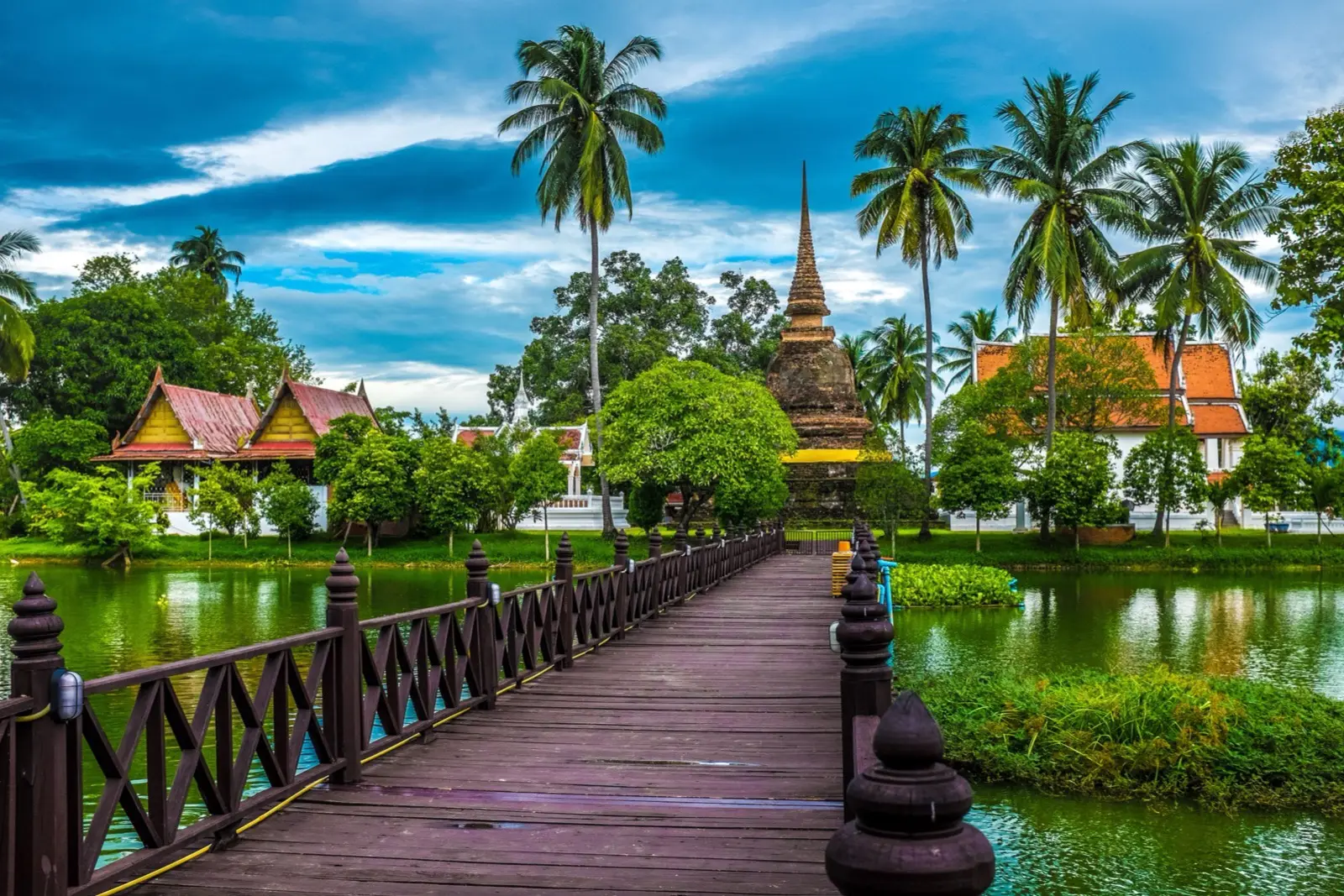
Thailand is an easy country to travel in and a surprisingly easy one to get wrong. Almost everything below is a single fact that saves an hour, a fine or an argument.
First-day basics
- Thailand is on UTC+7 all year; there is no daylight saving.
- The dialling code is +66; drop the leading zero of a local number when calling from abroad.
- Official documents use the Buddhist calendar — add 543 to the Gregorian year (2026 = 2569).
- Traffic drives on the left. As a pedestrian, look right first.
- Bangkok's backbone is the BTS Skytrain and the MRT metro. They sell separate tickets, and the Rabbit card works only on the BTS.
- Domestic flights are the intercity backbone: Bangkok–Chiang Mai about 1h15, Bangkok–Phuket about 1h25.
- 7-Eleven stores are everywhere and combine SIM top-ups, bill payment, ready meals and an ATM.
- Hotels and upmarket restaurants may add 7% VAT and a 10% service charge; the "++" beside a price is the signal.
Money and payment
The currency is the Thai baht (THB). Cards and QR payment are widespread in cities, but street food, markets and small towns still run largely on cash.
- Foreign cards are charged a 220 THB bank fee per ATM withdrawal. Taking out more, less often, reduces the cost.
- If an ATM or terminal offers to charge you in your own currency, decline and choose THB; dynamic currency conversion worsens the rate.
- The local QR system is PromptPay; even street stalls display a code.
- Bargaining is normal in markets and with tuk-tuks. Supermarkets, hotels and metered taxis are fixed-price.
- Small stalls may not be able to change a 1,000 THB note. Break it with a small purchase at 7-Eleven.
- City exchange offices give noticeably better rates than airport counters.
- Temple and national park entrances usually take cash only.
SIM cards and data
Mobile data is cheap and coverage is wide, islands included. Buying a tourist plan at the airport or loading an eSIM in advance takes a few minutes.
- The operators are AIS, TrueMove H and dtac; tourist SIM desks are in the arrivals halls.
- Tourist plans are usually sold as 8, 15 or 30 days of unlimited data.
- A passport is required to register a SIM; it is done at the desk.
- On an eSIM-capable phone you can load Airalo, Holafly or AIS's own eSIM before you fly.
- Top-ups and renewals can be done at any 7-Eleven.
- Free Wi-Fi is common in cafés, hotels and malls; speeds drop noticeably on smaller islands.
Water, food and street stalls
Tap water is not used for drinking, and bottled water is cheap everywhere. Street food is central to the cuisine, and choosing a stall is a practical skill rather than a gamble.
- Do not drink tap water. A 1.5 litre bottle costs about 15 THB.
- Cities have refill machines dispensing drinking water for a 1 THB coin, usable with a reusable bottle.
- Ice at stalls and restaurants is factory-made — the cylinders with a hole through the middle.
- For street food, pick the stalls with fast turnover and a queue of locals.
- For spice, "mai phet" (not spicy) or "phet nit noi" (a little spicy) is enough.
- Fruit stalls keep cut fruit on ice and sell it for the same day.
The eight scams
These are the ones visitors meet most often. Each starts the same way every time, which is what makes them easy to refuse.
- "The temple is closed." Confirm closures at the official ticket office — the Grand Palace is open every day of the week.
- The cheap tuk-tuk tour. Decline. The low fare is recovered through commission from gem and tailor shops.
- The gem scam. Buy no stones. Returns and independent appraisal do not work out in practice.
- Jet ski damage. Film the craft from every angle before renting, and never leave your passport as security.
- The broken meter. Get out and flag another taxi, or order through Grab or Bolt.
- The inflated bar bill. Don't enter venues you are invited into from the street; the bill arrives with items that were never on the menu.
- Motorbike damage claim. Offer a cash deposit instead of your passport, film the bike at pickup and keep the receipt.
- Temple clothing sale. Major temples such as the Grand Palace lend cover-ups free of charge; ask at the official entrance.
Etiquette — and where it becomes law
Everyday courtesy in Thailand is more binding than it looks. Most of the following are manners. Two of them carry legal consequences.
- Remove your shoes to enter a temple; shoulders and knees must be covered.
- Greetings are made with the wai, palms together; the elder person is greeted first.
- Touching someone's head is disrespectful — including patting a child's head.
- Pointing the soles of your feet at people or at Buddha images is rude.
- Raising your voice or losing your temper causes serious loss of face; even haggling is done with a smile.
- Women do not touch monks directly; items are passed by placing them on a surface in between.
- Using Buddha images as tattoos, wall decoration or anywhere feet may touch them is prohibited.
- Stepping on Thai banknotes or on images of the royal family is prohibited.
The rules that carry penalties
Some prohibitions are enforced far more strictly than visitors expect. The penalty beside each is the one recorded in the app's own data.
| Prohibition | Penalty |
|---|---|
| Bringing in or possessing e-cigarettes and heated tobacco (vapes, IQOS) | detention |
| Insulting statements, posts or behaviour concerning the royal family | prison |
| Possessing or carrying narcotics | prison |
| Cannabis outside medical use; buying without a prescription, using in public | fine |
| Smoking on many beaches and in public areas | fine |
| Going topless or nude in public | fine |
| Taking Buddha statues and images out of the country without a permit | fine |
| Drone use without registration and permission; in national parks and near airports | fine |
E-cigarettes are not merely restricted in Thailand — bringing one in is an offence that carries detention. Leave it at home.
Airports, taxis and driving
From Bangkok Suvarnabhumi (BKK)
- Airport Rail Link — about 30 minutes, roughly $1.
- Official taxi — about 50 minutes, roughly $12. Payment to the city centre typically lands in the 350–450 THB range.
- Use the official taxi queue on the 1st floor, not the fixed-price offers on the arrivals floor.
- There is a 50 THB airport surcharge, and tolls are the passenger's responsibility.
- Grab and Bolt work from the airport; the meeting point is at the parking level.
If you drive
- Traffic drives on the left with the wheel on the right.
- Helmets are compulsory on motorbikes — riding without one is the fine tourists receive most often.
- An International Driving Permit is asked for both when renting and at police checks; motorbikes need category A.
- Rental shops may ask for your passport as security. Offer a cash deposit instead, and film the vehicle at pickup.
- Attendants fill the tank; specify "gasohol 91/95" or "diesel".
- National park and mountain roads have no lighting. Plan to arrive before sunset.
If something goes wrong
- Tourist Police 1155 — answers in English and routes you to the right service.
- Police 191, medical emergencies and ambulance 1669, fire brigade 199.
- The Tourism Authority (TAT) information line 1672 answers in English during the day.
- If a passport is lost, get a police report first, then go to your own country's mission.
- Most countries keep their embassy in Bangkok; Chiang Mai and Phuket may have honorary consulates.
- Keep your bank's card-blocking number somewhere other than your phone, and a copy of your passport separate from it.
Electricity, in one line
220V at 50Hz, hybrid sockets that take Type A, B, C and the local Type O. If your charger says "100–240V" you need no converter. Power cuts happen at island and mountain guesthouses, so a power bank earns its place.
Where to next
What the trip costs and which apps to install are in the costs and apps guide. The destinations themselves are in parts one and two.
Visa, best season, a suggested route, costs and flight prices for Thailand — in one report, for your own passport.
Keep reading
 Vietnam
 travel tips: money, SIM, scams and the rules
Money, SIM, food, the licence rule, eight scams and the laws with real penalties.
 Thailand
Best time to visit Thailand, month by month
Two coasts, opposite rainy seasons, and a northern haze season nobody warns you about.