Vietnam Travel Tips: Money, SIM Cards, Scams and the Rules That Carry a Penalty
The things you only learn on day three — gathered here so you have them on day one.
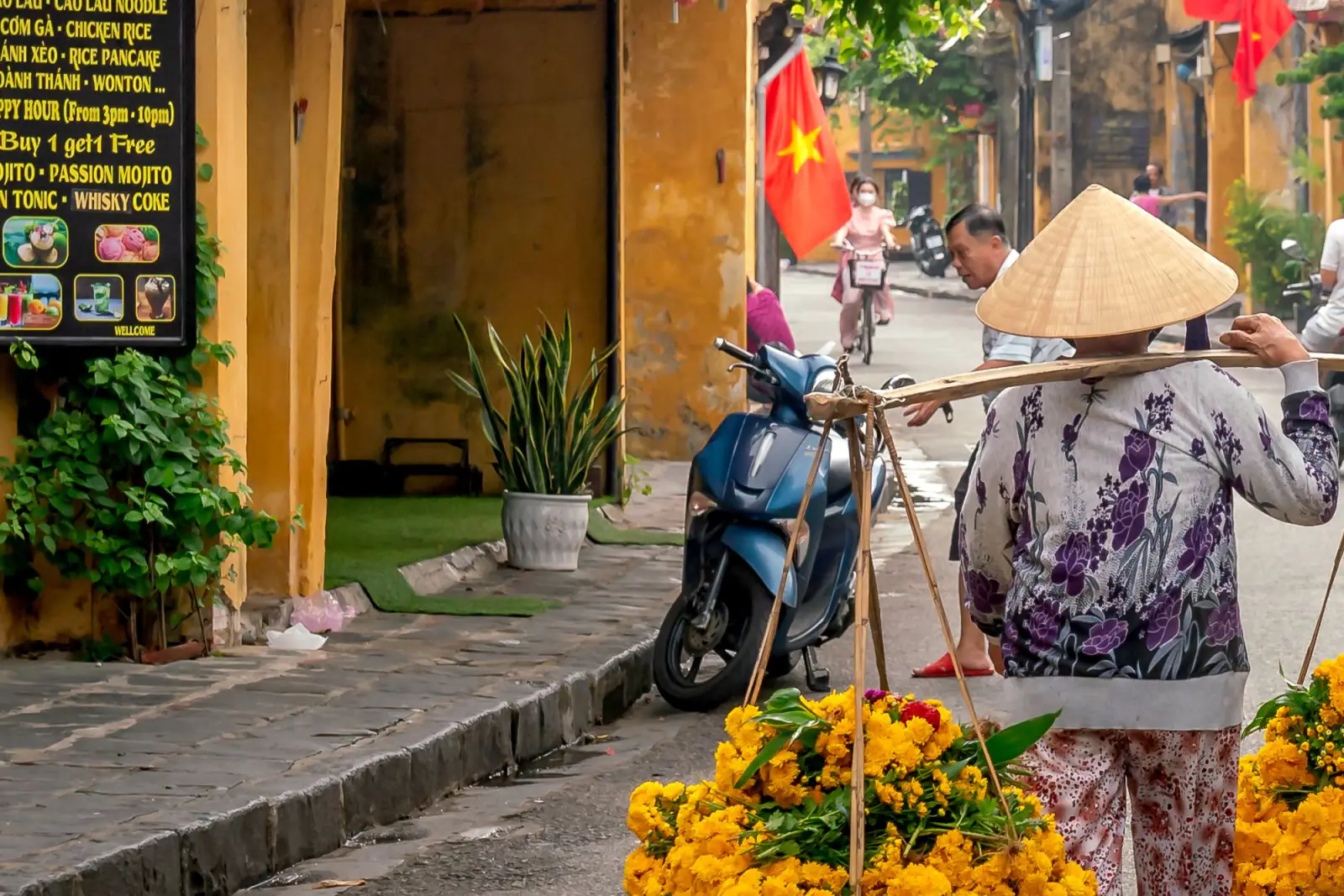
Money and payments
The currency is the Vietnamese dong and the figures are large: 100,000 VND is roughly four dollars. Hotels, malls and established restaurants take cards. Street food, markets, buses and small cafés are cash only.
- Keep notes sorted by value in separate compartments.
- ATMs charge a flat 22,000–66,000 VND per withdrawal; Eximbank and TPBank machines are the cheapest.
- Most banks cap a single withdrawal at 2–5 million VND. Withdraw the maximum to dilute the fee.
- If the machine offers to charge you in your own currency, decline and choose VND — dynamic currency conversion always worsens the rate.
- VietQR is the country's dominant payment method but needs a Vietnamese bank account, so it is out of reach on a short stay.
- Check before you travel that your card is enabled for use abroad, and what its daily limit is.
Getting online
Mobile internet is cheap and fast, with continuous 4G along the coast and the intercity roads. Viettel has the widest coverage, and the difference shows in Sapa and the mountains. Vinaphone and Mobifone match it in the cities and along the coast.
- A local SIM is sold at the airport and at official dealers, against your passport.
- Load an eSIM plan before you fly. Setting one up at the airport requires connecting to wifi first — exactly when you least want to be troubleshooting.
- Coverage drops in Ha Long Bay, the Phong Nha caves and on mountain trails. Download offline maps.
- Zalo is the messaging app in general use — hotels, tours and motorbike rentals all correspond through it.
- Almost every café and guesthouse has free wifi, with the password written on the table.
From the airport
Arriving at Tan Son Nhat (SGN) in Ho Chi Minh City, there are three ways into the centre:
| Option | Time | Cost |
|---|---|---|
| Bus | ~50 min | ~$1 |
| Ride-hailing (Grab, Be, Xanh SM) | ~30 min | ~$6 |
| Official taxi | ~25 min | ~$7 |
- Ride-hailing apps work at the airport, with a separate meeting point marked at the terminal exit.
- The official taxi brands are Vinasun and Mai Linh. Make sure the meter is on; the airport surcharge is shown separately.
- Yellow bus 109 runs to Pham Ngu Lao and Ben Thanh, paid in cash on board. Bus 152 is cheaper but charges a second ticket for large luggage.
- When you call a car from the app, match the plate and the driver's name on screen before you get in.
Food and water
Tap water is not for drinking — locals drink bottled or boiled water too. On the food side, high-turnover street kitchens are the country's main form of eating out, and they are generally where the best food is.
- Most accommodation provides free bottles or a water cooler.
- In established places the ice is factory-made — cylinders with a hole through the middle. That is the shape to look for.
- At a street kitchen, judge by how fast the counter turns over and whether the food comes out hot.
- Fresh herbs and raw sprouts arrive alongside phở and bún chả. Go easy on them in your first few days.
- Coffee is brewed strong and thick; cà phê sữa đá comes with condensed milk over ice.
- Bia hơi is fresh draught beer, brewed daily and sold at pavement stalls in the late afternoon.
- For spice, không cay (not spicy) is understood everywhere.
Renting a motorbike — read this one
Renting a motorbike is the most common way to get around, and it is also where foreign riders get it wrong most often. The licence rule is strict, and riding on an invalid document means both a heavy fine and your cover falling away.
- A petrol motorbike above 50cc requires a motorcycle-class licence together with a valid international permit.
- No licence is required for electric scooters under 50 km/h design speed and under 4 kW.
- Riding without a valid document is fined 2–4 million VND up to 125cc and 6–8 million VND above it, with the bike impounded for seven working days.
- Helmets are compulsory for rider and passenger, worn and fastened.
- Alcohol tolerance is zero, and roadside breath tests are routine in the evenings and at weekends.
- Speed limits are 50 km/h in built-up areas and 60 km/h outside. Holding a phone while riding is finable.
- Compulsory insurance covers only the other party. If an unlicensed rider is at fault, the rental contract's damage waiver can fall away too.
Eight scams, and what to say
None of these are dangerous. All of them are easier to refuse when you have seen the opening line before.
1. The fast meter
"Vinasun is full, I'm the same company, get in." — a car imitating the official brands, outside an airport or a sight. Take only Vinasun and Mai Linh, or book through Grab, Be or Xanh SM.
2. The photo yoke
"Take a photo, it's free, a souvenir." — someone places a bamboo yoke with fruit baskets on your shoulder. Don't take it; if it is already on you, hand it straight back and keep walking.
3. Shoe polishing
"Look, it's torn here, let me fix it right now." — they start without waiting for permission. Say "Không, cảm ơn" and pull your foot back; if they have started, get the price written down first.
4. The English menu
"This is our tourist menu, the portions are larger." — a different menu from the priced one at the door. Order from the priced menu and confirm each item before the bill comes.
5. Motorbike damage
"This happened with you, the repair is expensive, I need to hold your passport." Never leave your passport as a deposit. Offer cash instead, and film the bike from every angle at pick-up.
6. The banknote switch
"I gave you your change, count it if you like." — a similarly coloured 20,000 note in place of a 500,000. Count your change in front of the seller and check the zeros.
7. The cyclo ride
"That price was per person, so it's double for the two of you." Confirm the total, the duration and the number of people in writing before you get in.
8. The fake app driver
"I'm your Grab, your booking is showing on my screen, come on." — someone waving a phone outside the airport. Don't get in before matching the plate and driver name against your app.
Manners
Daily interaction rests on not raising your voice and not causing anyone to lose face. Most of the following are manners; one of them carries a legal penalty.
- Shoes come off at homes, temples and some small shops.
- Giving and receiving with two hands — or supporting your right hand with your left — shows respect.
- Raising your voice or arguing in public is taken badly, because it makes the other person lose face.
- Shoulders and knees stay covered in temples and pagodas, and you do not photograph yourself with your back to a Buddha statue.
- Chopsticks are never stood upright in rice — it resembles incense sticks and is considered unlucky.
- Touching someone's head, pointing with your foot or turning your sole towards someone is rude.
- The bill is usually paid by whoever invited, or by the oldest person at the table.
- Photographing military installations, border zones and airport control points is prohibited — this is the one with a legal penalty, not a social one.
Laws that carry a real penalty
Some of these protect public order, others cultural heritage and natural assets. The penalties around narcotics are among the heaviest in the country.
| Rule | Penalty |
|---|---|
| Possessing, carrying or selling narcotics — reaching the maximum depending on quantity | Prison |
| Taking antiques, historical artefacts or religious objects out of the country without permission | Prison |
| Buying or carrying products made from protected species | Prison |
| Photographing military installations, border zones, airport control points | Detention |
| Gambling outside licensed venues | Fine |
| Riding or carrying a passenger without a helmet | Fine |
| Smoking in enclosed public spaces | Fine |
| Flying a drone without prior authorisation | Fine + device confiscated |
Tipping, power and emergency numbers
Tipping
Tipping is not an established custom and is not expected in most places. No tip is expected at street kitchens and local cafés. Hotels and tourist restaurants may add a 5% service charge and 8% VAT as separate lines on the bill — if a service charge has been added, no further tip is expected. On guided tours it is common to leave a small amount per day for the guide and the driver. Taxi and app fares are rounded up rather than tipped on top. When you do tip, handing the note over with two hands is better received than leaving it on the table.
Power
Mains voltage is 220 V at 50 Hz nationwide. The socket type is not standardised and different types appear in the same building: A (flat pins), C and F (round pins). The two-pin European plug fits most sockets. Type A is more common in the south, C and F in the north — though this is a tendency, not a rule. For earthed three-pin devices, carry a universal adapter. Power cuts are routine in older buildings and on the islands, so carry a power bank. Phone, tablet and laptop chargers are dual-voltage and run on 220 V without trouble.
Emergency numbers
Police 113 · Fire and rescue 114 · Ambulance 115. They are the same nationwide and free to call, but operators mostly speak Vietnamese only.
- Keep your street name and ward (phường) written down in Vietnamese.
- Carry your accommodation's business card — showing the address is faster than describing it.
- In the large cities the international clinics run their own English-language call lines.
- Where coverage drops — Ha Long, Phong Nha, Sapa — write your tour operator's number on paper.
Travelling solo
Solo travel is very common here and the infrastructure is set up for it. Many hostels in Hanoi, Ho Chi Minh City, Da Nang and Hoi An offer female-only dorms. On night trains the four-berth soft sleeper cabins are sold separately and you can pick your cabin when booking. Grab, Be and Xanh SM show the driver, plate and route in the app and let you share the trip; the Xanh SM electric fleet quotes a fixed fare and offers a female driver option in some cities. Carry a light scarf for temple days, and use the paid luggage lockers common in hostels so you can see the city before check-in.
That is the practical layer. For what it all costs, see the budget breakdown; for when to go, the month-by-month guide.
Visa, best season, a suggested route, costs and flight prices for Vietnam — in one report, for your own passport.
Keep reading
 Vietnam
Best time to visit Vietnam, month by month
Three climates, one country. February works almost everywhere; July to September works nowhere.
 Vietnam
Things to do in Hanoi, Saigon, Ha Long and Hoi An
Fifty-five places across the four destinations most itineraries are built around.